
Northeast Ohio spends much of the winter crossing back and forth over the freezing mark, and a flat roof feels every one of those crossings. Water with nowhere to go freezes, expands, and thaws again, and our commercial roof repair and maintenance work through November largely focuses on closing the openings that cycle will find.
How Do Freeze and Thaw Cycles Affect Flat Commercial Roofs?
Freeze and thaw cycles affect a flat roof by turning trapped water into a mechanical force. Water expands as it freezes, so moisture in a crack, seam, flashing gap, or low spot pushes outward on the surrounding material. When the temperature rises again, the water retreats and leaves the opening slightly wider than it was. Repeat that over a winter and small defects can become paths into the assembly.
A flat roof is more exposed than a pitched one because of drainage speed. A sloped residential roof sheds water in minutes. A low-slope commercial roof moves water sideways across a shallow pitch toward drains or scuppers, which gives moisture far more opportunity to sit, soak in, and freeze in place.
Standing Water Is the Starting Point
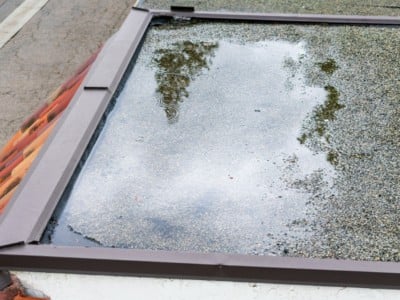
Almost every freeze-related problem begins with water that did not leave. Ponding on a flat roof is a drainage symptom in any season, but in winter it becomes a loading and expansion problem as well. A pool that freezes adds weight in one concentrated area, and the ice it forms can be slow to clear even when the air warms.
Frozen ponding also hides the surface underneath it. You can’t assess membrane damage, open laps, or debris through several inches of ice, so a defect that formed in December may go unseen until spring. Addressing drainage issues on a commercial roof in the fall is what keeps that from happening.
Small Cracks and Surface Splits
Minor cracking is common on an aging flat roof and does not always indicate a failure. What changes in winter is the consequence. A hairline split that sheds water in July can hold water in January, and water held inside a crack has somewhere to expand when it freezes.
Cold weather also stiffens roofing materials. Membranes and bitumen that flex in warm temperatures become more rigid as they cool, which reduces how much movement they can absorb. A flat roof already showing surface cracks tends to show more after a hard winter, which is why fall is the practical window for repairs.
Seams and Laps Under Winter Stress
Seams are the joints between membrane sheets, and they carry stress that the roof’s open field does not. Thermal movement pulls on them as temperatures swing, and a lap that has lost part of its bond gives meltwater a direct route beneath the surface. Once water is under the membrane, freezing can lift the sheet further and widen the opening.
Seam condition is one of the first things worth confirming before cold weather, since commercial roof seams that need repair are much easier to address in mild conditions. Adhesives and welding equipment both behave differently in the cold, and roof access is safer when the surface is dry.
Flashing Gaps and Transitions
Flashing handles every place the flat roof changes direction, including parapet walls, curbs, equipment stands, and roof edges. Those transitions involve folds and corners that are harder to seal than a flat lap, and they tend to sit where snow and ice linger longest.
A gap in flashing is a direct opening into the wall or the deck below. In summer, it admits rain that often dries. In winter, it admits meltwater that may freeze inside the assembly, where expansion can separate the metal further from the substrate it is fastened to.
Clogged Drains and Blocked Scuppers
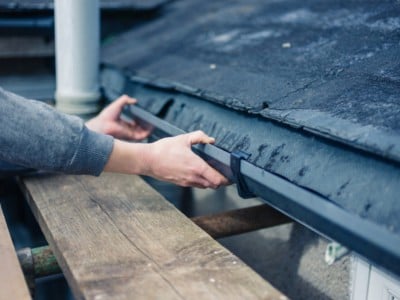
Drains and scuppers are the exit route, and leaves, seed pods, gravel, and general debris restrict them well before they look fully blocked. A partially clogged drain still moves water, just slowly enough for a pool to form during heavy rain or a rapid thaw.
Ice makes that worse by blocking the opening entirely. A drain that was slow in October can be sealed shut by January, and the meltwater from a midwinter thaw then has nowhere to go. Clearing the drainage path before the first freeze is one of the highest value tasks on any flat roof.
Overflow Provisions
Many commercial roof designs include secondary or overflow drainage where required by code or design. That path is a safety measure rather than a working drain. If water routinely leaves a building through an overflow, the primary system has already stopped doing its job and should be examined before winter.
Inspection Points for Property Managers
A pre-winter inspection on a flat roof is mostly a matter of confirming that water can leave and that nothing is open. A professional will typically walk the drainage path, probe seams, check flashing at every transition, examine the membrane around rooftop equipment, and look for areas where water has clearly been standing.
Documentation is the part that pays off later. Dated photos, notes on where you saw water, and a record of what you cleared or repaired make the spring inspection faster and give a building owner a usable history. A commercial roof survival guide approach to winter starts with knowing what condition the roof was in before the snow arrived.
Access and Safety
Roof access points, ladders, hatches, and walk pads deserve a look in the same visit. Winter access is sometimes necessary for snow loading concerns or equipment service, and a hatch that does not seal or a walkway that has shifted creates both a leak path and a safety issue.
Pre-Winter Flat Roof Checklist
Use this as a starting point when preparing a flat roof for the season.
- Clear every drain, scupper, strainer, and collector box of debris.
- Confirm that strainers and drain domes are present and intact.
- Note any area where water stands well after rainfall has stopped.
- Check seams and laps for lifting, wrinkling, or open edges.
- Inspect flashing at parapets, curbs, edges, and equipment stands.
- Look for cracks, splits, blisters, or punctures in the membrane.
- Examine the membrane around rooftop units and along traffic paths.
- Verify that roof hatches and access points close and seal properly.
- Photograph findings with dates and keep them on file.
- Schedule professional repairs while conditions are still mild.
Talk to Us Before the First Freeze
If your building has standing water, an open seam, or a drain you are not sure about, Brad Smith Roofing can evaluate it before the weather turns. Our team provides commercial roofing services that include inspections, leak detection, repairs, ongoing maintenance, and snow and ice removal through the winter. Call us at 440-835-3377 or contact us on our website to schedule an inspection for your property.
Frequently Asked Questions
1. What is a Freeze and Thaw Cycle?
It is a temperature swing that takes water above and below freezing. Water expands as it freezes and contracts as it thaws, and that repeated movement stresses whatever material holds it.
2. Why Are Low Slope Roofs More Affected Than Pitched Roofs?
Low slope roofs move water sideways across a shallow pitch rather than shedding it quickly by gravity. That gives moisture more time to sit on the surface, soak into openings, and freeze in place.
3. Is Ponding Water a Problem in Winter?
It can be. Frozen ponding adds concentrated weight, clears slowly, and conceals the membrane underneath, making any damage that develops beneath the ice hard to find until spring.
4. When Should a Commercial Roof Be Inspected for Winter?
Fall is the practical window, ideally before the first sustained freeze. That timing allows repairs to be made in mild conditions and confirms the drainage path is open before snow arrives.
5. Can Repairs Be Done in Cold Weather?
Some can, but conditions limit the options. Adhesives and sealants are temperature-sensitive, surfaces must be dry, and roof access is less safe, so it’s best to schedule work before winter sets in.
6. How Do Cracks Form in Roofing Membranes?
Membranes expand and contract with temperature, and materials stiffen as they cool. Over many cycles that movement can produce surface splits, particularly on older assemblies with less flexibility left.
7. Does Snow Weight Damage Commercial Roofs?
Accumulated snow adds load, and drifting can concentrate that load in specific areas. Blocked drainage makes it worse by holding meltwater on the surface instead of letting it leave.
8. What Should Be Documented Before Winter?
Record the condition of drains, seams, flashing, and the membrane, note where water was standing, and photograph everything with dates. That record makes the next inspection faster and more useful.
9. How Often Should Drains Be Cleared?
At least twice a year for most buildings, in spring and fall, with additional attention on properties surrounded by trees or with frequent rooftop equipment work.
10. What Should I Do if I Find Ice on My Roof?
Avoid removing it yourself, since chipping ice can puncture the membrane and winter roof access is hazardous. Document what you see and contact a roofing professional.

Stacey is a graduate of BGSU, where she graduated with a B.A. in Interpersonal Communication and a Minor in Marketing. Stacey’s focus of study was Business Management. Stacey has been with the Company since November of 1999, she became the Office Manager in 2003. Stacey now serves as the Vice-President for the Company. She has been a Member of the Rocky River Chamber of Commerce since 2016. Stacey and her brother, Drew Smith, continue to follow in their Father’s footsteps bringing new innovations, new programs, new products and new techniques to help the Company’s efficiency, safety and customer satisfaction.
