
Once snow covers a commercial roof, most of it stops being inspectable until spring. That is the practical argument for finishing commercial roof repair and maintenance in the fall rather than discovering a problem in February, when access is limited and the surface is buried.
What Commercial Roof Maintenance Should Be Done Before Snow Arrives?
The work that matters most before snow falls is the work that confirms water can leave the roof and that nothing is open to the assembly below. In practice that means clearing the drainage path, checking seams and flashing, examining the membrane around rooftop equipment, confirming that access points seal, and documenting the condition of everything inspected.
Timing is part of the answer. Repairs in mild conditions use adhesives and sealants within their intended temperature range, crews work on dry surfaces, and the building owner has time to plan instead of react. Late fall commercial roof maintenance is largely about removing the surprises that winter would otherwise deliver.
Start With Drains and Scuppers
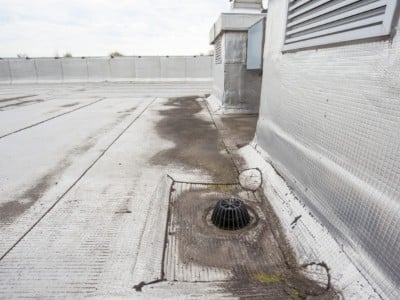
Drainage is the first item because everything else depends on it. Leaves, seed pods, gravel, and general debris restrict drains and scuppers long before they appear blocked, and a partially restricted drain still moves water, just slowly enough for a pool to form during heavy rain or a fast thaw.
Ice turns a restriction into a stoppage. A drain that was slow in October can be sealed by January, which leaves meltwater sitting on the surface with nowhere to go. Any list of commercial roof maintenance priorities should put drains, strainers, scupper openings, collector boxes, and downspouts at the top. Persistent drainage issues on a commercial roof are worth resolving before the season rather than during it.
Seams and Laps
Seams are the joints between membrane sheets and carry stress that the open field does not. Temperature swings pull on them, and a lap that has lost part of its bond offers meltwater a direct route beneath the membrane, where it can travel and surface well away from the opening.
A professional seam check is hands-on. It involves probing to find sections that have lost their bond, looking for lifted edges, wrinkles, and fishmouths, and paying particular attention to seams that sit where water collects. Seam work is a core part of commercial roof maintenance on any membrane system.
Flashing and Transitions
Flashing handles every change of direction on the roof, including parapet walls, curbs, equipment stands, and edge terminations. Those details involve corners and folds that are harder to seal than a flat lap, and they tend to sit where snow and ice linger after the open field has cleared.
A gap in flashing is a direct path into the wall or the deck. Meltwater entering there can freeze inside the assembly, and expansion can separate the metal further from what it is fastened to. Checking every transition is one of the higher-value items in fall commercial roof maintenance.
Rooftop Equipment Areas
Mechanical units, exhaust fans, conduit runs, and equipment stands all break the membrane plane, and each one adds seams and flashing details. They also bring service technicians onto the roof, so those areas tend to show wear before the rest of the surface does.
Before winter, the area around each unit deserves a close look for scuffs, punctures, compressed insulation, and separated flashing at the curb. Condensate lines are worth checking as well, since a line that discharges onto the membrane keeps one area wet through the season, which is why equipment areas get their own pass during commercial roof maintenance.
Membrane Condition Across the Field
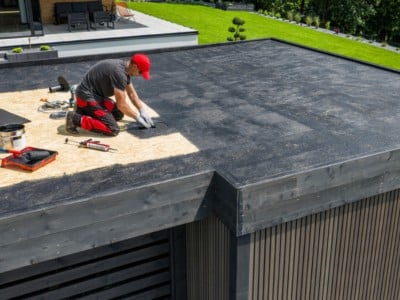
Walk the open field of the roof for splits, blisters, punctures, and areas worn by traffic. Cold weather stiffens roofing materials, which reduces how much movement they can absorb, so a marginal area in November has less tolerance in January.
Debris removal belongs here too. Branches, loose gravel, and construction leftovers can abrade the membrane under snow load or be driven into it by wind. Clearing the field is simple commercial roof maintenance that prevents damage no one would see until the thaw.
Roof Access and Safety Points
Hatches, ladders, walk pads, and perimeter safety equipment should be confirmed in the same visit. Winter access is sometimes necessary for snow loading concerns or equipment service, and a hatch that does not seal is both a leak path and a cold air path into the building.
Walk pads matter more than they appear to. A defined path keeps technicians off the vulnerable areas of the membrane, and a pad that has shifted or lifted stops doing its job. Confirming them is a small part of commercial roof maintenance with a long payoff.
Documentation Before the Snow
The record created in the fall is what makes the spring inspection useful. Photographs with dates, notes on where water was observed, a list of what was cleared and what was repaired, and any outstanding items form a baseline that shows exactly what changed over the winter.
That record also helps when snow removal becomes necessary. A crew working on a buried roof benefits from knowing where the drains, the equipment, and the vulnerable areas are. Planning for professional ice and snow removal is easier when the roof was documented before it disappeared under snow.
Pre-Snow Commercial Roof Checklist
Use this as a starting point for commercial roof maintenance before the season turns.
- Clear all drains, strainers, scuppers, collector boxes, and downspouts.
- Confirm that drain domes and strainers are present and undamaged.
- Note any area where water stands well after rain has stopped.
- Probe seams and laps for lifted edges, wrinkles, and open sections.
- Inspect flashing at parapets, curbs, edges, and penetrations.
- Examine the membrane around every rooftop unit and along traffic paths.
- Check condensate lines for discharge onto the membrane.
- Walk the open field for splits, blisters, punctures, and debris.
- Confirm hatches, ladders, and walk pads are secure and sealing.
- Photograph everything with dates and file the record.
Why Fall Beats Midwinter
Scheduling commercial roof maintenance is easier before the first storm, conditions are safer for crews, and material behavior is more predictable in mild temperatures. There is also the simple matter of visibility, since a buried roof cannot be assessed. The case for timing this work well applies to late fall as strongly as it does to late summer.
Talk to Us Before the First Snow
If your building has not been looked at this fall, Brad Smith Roofing can get it on the schedule. Our team provides commercial roofing services that include inspections, leak detection, repairs, ongoing maintenance, and snow and ice removal once winter arrives. Call us at 440-835-3377 or contact us on our website to schedule an inspection for your property.
Frequently Asked Questions
1. When Should Fall Roof Work Be Completed?
Before the first sustained freeze is the practical target. That allows repairs to be made in mild conditions and confirms the drainage path is open before snow and ice arrive.
2. Why Are Drains the First Priority?
Everything else on a low slope roof depends on water leaving. A restricted drain allows ponding, and ice can close a restricted drain completely once temperatures fall.
3. Can Membrane Repairs Be Made in Cold Weather?
Some can, but options narrow. Adhesives and sealants are temperature-sensitive, surfaces must be dry, and roof access is less safe, so it’s better to schedule work in advance.
4. How Often Should a Commercial Roof Be Inspected?
Twice yearly is a common baseline, in spring and fall, with additional checks after severe storms and after any significant rooftop equipment work.
5. What Should Be Checked Around Rooftop Units?
Look for scuffed or punctured membrane, compressed insulation, separated curb flashing, and condensate lines discharging onto the roof surface rather than into a drain.
6. Does Snow Weight Damage Flat Roofs?
Accumulated snow adds load and drifting can concentrate it in specific areas. Blocked drainage compounds the issue by holding meltwater on the surface instead of releasing it.
7. Should Snow Be Removed From a Commercial Roof?
Sometimes, depending on accumulation and the building. It is work for a professional, since improper removal can puncture the membrane and winter roof access carries real risk.
8. What Records Should a Property Manager Keep?
Dated photographs, notes on standing water, a list of what was cleared or repaired, and any outstanding items. That baseline makes the spring inspection faster and more accurate.
9. Why Do Walk Pads Matter?
They keep foot traffic off vulnerable areas of the membrane by defining a path. A pad that has shifted or lifted no longer protects the surface it was installed to cover.
10. What if a Problem Is Found Late in the Season?
It is still better to know. Temporary measures can protect the roof until conditions allow a permanent repair, and documentation keeps the item from being forgotten until spring.

Stacey is a graduate of BGSU, where she graduated with a B.A. in Interpersonal Communication and a Minor in Marketing. Stacey’s focus of study was Business Management. Stacey has been with the Company since November of 1999, she became the Office Manager in 2003. Stacey now serves as the Vice-President for the Company. She has been a Member of the Rocky River Chamber of Commerce since 2016. Stacey and her brother, Drew Smith, continue to follow in their Father’s footsteps bringing new innovations, new programs, new products and new techniques to help the Company’s efficiency, safety and customer satisfaction.
